
I used to think taking ownership of a project meant absorbing every unresolved decision around it. I did not yet have language for the project manager authority gap: the space between owning an outcome and having the authority to make every decision that shapes it.
If a client had not approved something, I followed up. If two team members interpreted the direction differently, I tried to reconcile it. If a deadline was in danger, I looked for a way to keep the work moving. That instinct came from a responsible place. I wanted the project to succeed, and I did not want uncertainty to become an excuse for inaction.
But somewhere along the way, I began treating every unresolved decision as though it had become mine simply because I was the project manager.
That created a difficult pattern. If I waited for the appropriate decision-maker, the project could appear stalled on my watch. If I moved ahead without a clear decision, I risked committing the team to work that had not actually been authorized. I was accountable for delivery, but I did not control every choice that determined whether delivery was possible.
Experience has taught me that ownership does not mean silently inheriting authority that was never assigned. Sometimes ownership means recognizing where my authority ends, identifying the decision that is blocking progress, and making that dependency visible before it becomes a crisis.
Responsibility becomes workable when decision rights, escalation paths, and boundaries of authority are made explicit.
What the Project Manager Authority Gap Looks Like
Project managers are often responsible for schedule, coordination, communication, risk visibility, and the overall movement of the work. Yet many of the decisions that shape those outcomes sit elsewhere. A sponsor may control funding. A department leader may control staffing. A client may hold final approval. An executive may determine strategic priority. A specialist may own the technical judgment behind an integration, compliance requirement, or launch recommendation.
That separation is not automatically a sign of dysfunction. Projects cross organizational boundaries, so authority is naturally distributed. The problem begins when responsibility is clear but decision rights are not.
In that environment, the project manager becomes the visible owner of a system he or she cannot fully direct. The schedule may show a delay, but the real constraint is an unanswered scope decision. The team may appear under-resourced, but the PM cannot assign additional staff. A launch date may be at risk, but only someone else can accept the remaining risk or authorize more time.
The project manager authority gap is the distance between the outcome a project manager is expected to deliver and the decisions the project manager is actually empowered to make.
Why the gap creates hidden project risk
The authority gap is easy to miss because project managers are trained to solve problems. We translate, coordinate, persuade, follow up, and look for tradeoffs. Those are valuable skills. They can also conceal a structural dependency when we use them to compensate indefinitely for unclear ownership.
A PM may keep chasing an approval without naming when the delay will affect the schedule. Another may make a reasonable assumption but fail to record who accepted the risk. Another may repeatedly ask leadership what to do without first framing the options and recommending a path. In each case, the issue is not simply communication. The decision itself has not been placed in a visible structure.
Silence does not automatically transfer decision authority. Neither does urgency. If the project manager has not been given the right to change scope, approve additional cost, reprioritize departments, or waive a launch requirement, the absence of a response does not quietly create that right.
What the PM does own is the responsibility to expose the decision, explain the tradeoffs, identify the appropriate owner, recommend a course when possible, and show the consequence of delay. That is not stepping away from ownership. It is exercising it more accurately.
From managing tasks to navigating the system
This tension is especially relevant to where the project-management profession is heading. PMI’s 2026 Pulse of the Profession describes unclear decision-making authority, competing priorities, stalled approvals, and recurring questions of ownership as forms of organizational complexity. Its broader argument is that modern project professionals must move beyond controlling tasks and learn to navigate interconnected systems.
That distinction matters. A delayed decision is rarely just an empty cell in a tracker. It may reflect competing incentives, hidden approval layers, limited resources, or two leaders working from different definitions of success. Pushing the task harder will not necessarily resolve the system around it.
PMI’s 2025 work on business acumen makes a related point: project professionals create more value when they look beyond schedule, scope, and budget and assess the wider business priorities and tradeoffs surrounding the work. That does not mean the PM should make every business decision. It means the PM should understand enough of the business context to frame those decisions well and route them to the right level.
Strategic execution requires informed autonomy, not unlimited authority. The PM needs enough room to manage the work, enough context to make sound recommendations, and a dependable path for decisions that belong elsewhere.
A lightweight decision-rights framework
I have found it useful to separate project decisions into five categories. The purpose is not to add another approval process. It is to reduce unnecessary approvals while making the necessary ones unmistakable.
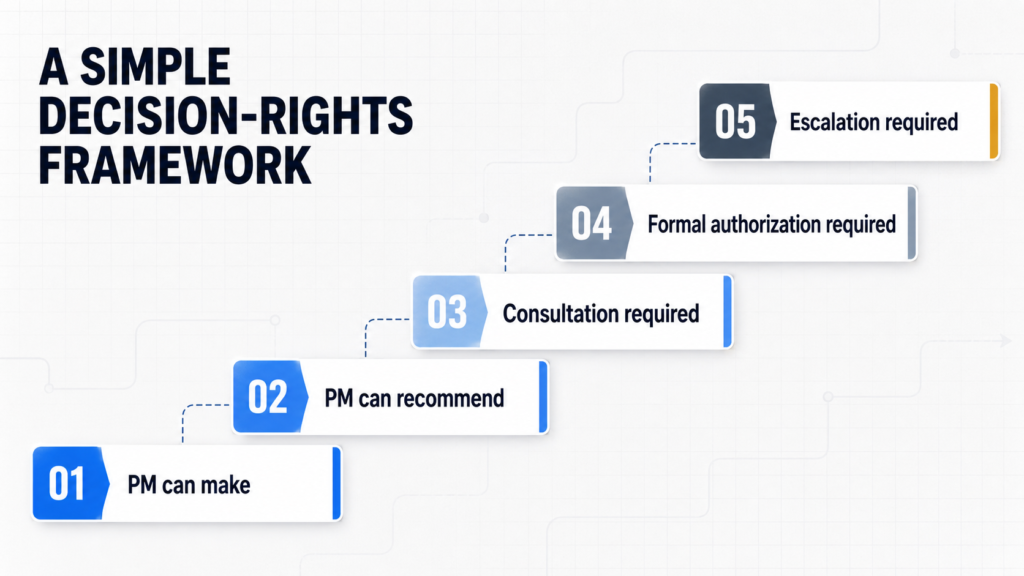
1. Decisions the PM can make
These decisions fall within agreed boundaries and do not materially alter scope, cost, quality, risk, or the intended outcome. They might include meeting cadence, follow-up methods, sequencing work within an approved plan, assigning routine internal due dates, or coordinating the implementation of an already approved direction.
A PM should not seek formal permission for every operational choice. Clear authority at this level is what allows the project to move without turning governance into a bottleneck.
2. Decisions the PM can recommend
Some choices require a business, client, or leadership decision, but the PM is close enough to the work to develop a strong recommendation. For example, the PM may recommend moving a lower-priority feature to a later phase, selecting one of two timeline options, or choosing the path that best protects launch readiness.
The PM should present the options, tradeoffs, preferred path, decision owner, and decision deadline. Recommending is not the same as deciding, but it prevents escalation from becoming an unstructured request for someone else to solve the entire problem.
3. Decisions requiring consultation
These decisions may sit within the PM’s authority, but they affect another area of expertise or responsibility. A change to a web form may need input from the developer who owns the integration. A design adjustment may require accessibility or brand consultation. A content choice may affect search strategy or legal review.
Consultation does not necessarily transfer the final decision. It ensures that the PM does not exercise legitimate authority without the information needed to use it responsibly.
4. Decisions requiring formal authorization
Some decisions should produce a clear, documented yes. Typical examples include expanding scope, approving added cost, changing a contractual milestone, accepting a significant quality or security risk, reallocating staff across priorities, authorizing launch, or approving final public-facing content.
The test is not whether the decision feels important. The better test is whether it commits money, changes an agreed boundary, creates material risk, or binds someone who has not delegated that authority to the PM.
5. Decisions that must be escalated
Escalation is appropriate when the decision owner is unavailable beyond an agreed response window, two authorized stakeholders give conflicting direction, the project is approaching an impact threshold, or the PM is being asked to accept a risk outside the boundaries of the role.
A useful escalation is specific: Here is the decision. Here is who normally owns it. Here are the viable options. Here is my recommendation. Here is the date by which we need an answer. Here is what changes if we do not receive one.
That is different from forwarding a long email thread or announcing that the project is blocked. The goal is to make the decision easier to make, while preserving the fact that it still belongs to the appropriate authority.
How to make the framework practical
Define recurring decision rights early.
At kickoff or planning, identify who can approve scope changes, added cost, content, design, integrations, launch readiness, and priority changes. Not every possible decision needs to be predicted. The recurring, high-impact ones usually can be.
Put a response window around important decisions.
A named decision owner helps, but timing matters too. If a client approval is expected within three business days, or a sponsor decision must occur before development begins, state that expectation and the consequence in advance.
Escalate the decision, not the frustration.
Escalation should make the issue more legible. Strip away the history that does not affect the choice. Give the decision-maker enough context to act, along with a recommendation whenever the PM has the information to make one.
Document the decision and the boundary it changes.
A concise written record protects more than accountability. It preserves the reasoning behind a tradeoff and helps the team understand what is now authorized.
Review exceptions after the project.
If the same kind of decision repeatedly stalls, the answer may not be more follow-up. It may be a clearer delegation rule, a shorter approval path, or an agreed threshold below which the PM can act without another review.
What the project manager still owns
A decision-rights framework should never become a shield against judgment. Project managers cannot respond to every ambiguity with, ‘That is not my decision.’ The role still requires initiative, influence, business understanding, and the willingness to recommend a path.
Even when I do not own the final choice, I may still own the work required to make that choice possible. I can clarify the issue, gather facts, identify the tradeoffs, consult the right people, offer a recommendation, record the outcome, update the plan, and escalate before the project absorbs avoidable damage.
That is the distinction I had not fully developed earlier in my career. I thought ownership meant carrying the unresolved decision until I found some way to absorb it. I now see ownership as making sure the decision is neither hidden nor orphaned.
Closing the project manager authority gap does not require giving the PM control over every decision
The question I ask now is not simply, ‘How do I keep this moving?’ I ask: What kind of decision is this? Who has the authority to make it? What can I recommend? Who needs to be consulted? By when do we need an answer? What happens if we do not get one?
Project managers do not need unlimited authority. They need enough authority to manage within agreed boundaries, enough business context to frame tradeoffs intelligently, and a clear route for decisions that sit beyond those boundaries.
When those elements are explicit, responsibility stops feeling like a vague personal burden and becomes something a project manager can actually carry.
This lesson is part of the larger professional growth I described in I Stumbled Into Project Management. Then I Chose It.
Sources and further reading
Project Management Institute. Pulse of the Profession 2026: Driving Success in Complex Projects. May 2026.
Project Management Institute. PMI Talent Triangle: The Key to Project Management Success. March 2025.
Let’s Connect
If anything strikes a chord,
I’d like to know.
Ideas get better when they are shared.
Go ahead and reach out!
Curiosity is the beginning of every meaningful conversation
Someone (probably)
