Why We Misunderstand Each Other Online
A simple picture of how communication works
We’ve all been there. You sent a text that felt totally normal to you… and the other person read it like you were angry.
Or you saw a short clip online, got fired up, and then later found out there was a whole backstory you never saw?
That’s not just “people being dumb.” A lot of it comes from how communication works in the first place.
A scientist named Claude Shannon studied communication while working on phone and signal systems. He wasn’t trying to write relationship advice. He was trying to help messages get from one place to another without getting messed up. But his model gives us a super helpful way to talk about everyday communication too.
Here’s the big idea:
When one person tries to communicate with another person, there are a few steps that always happen:
- A sender has an intended message
- That message gets turned into a signal and sent through a “channel”
- The other person receives the signal and interprets it
- “Noise” can mess with things at any step
And this is why miscommunication isn’t a rare accident. It’s a normal risk built into the process – especially online.
Shannon’s “message path” in plain English
Shannon described a basic chain that looks like this:
Source → Transmitter → Channel (with noise) → Receiver → Destination
That might sound technical, so let’s translate it into real life.
Source: “I have something in my head”
The source is where the message starts.
It could be:
- a thought (“I’m worried about you”)
- a feeling (“I’m hurt”)
- an idea (“Here’s why I think this is wrong”)
- a fact (“The game starts at 7”)
It’s what you mean to communicate – even before you say anything.
Transmitter: “How do I turn my thought into something shareable?”
The transmitter is whatever turns your thought into a signal that can travel.
In real life, your “transmitter” might be:
- your mouth (speaking)
- your hands (texting)
- your camera (recording)
- your keyboard (posting)
In Shannon’s work, the transmitter changes a message into a signal (like turning your words into an electrical signal on a phone line).
In normal life, this is where you choose words, tone, emojis, timing, and what you leave out.
And right here is Problem #1:
You might mean one thing, but choose signals that don’t clearly carry that meaning.
Example:
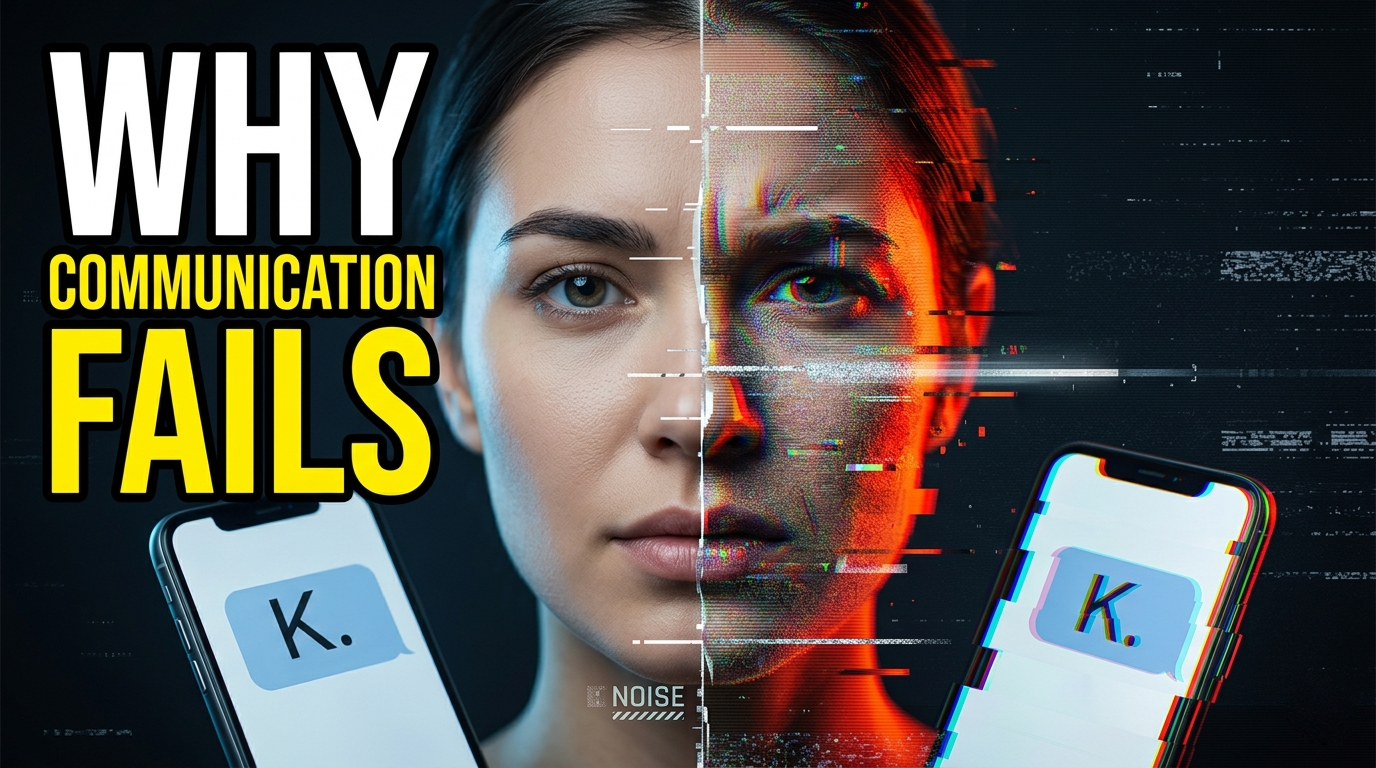
- You feel calm, but you text: “K.”
- You meant: “Okay.”
- The other person reads: “I’m mad.”
Channel: “What path does the message travel on?”
The channel is the medium the signal rides through.
Shannon said the channel is simply the medium that carries the signal from transmitter to receiver – like wires, radio, or light.
In your world, channels can be:
- a face-to-face talk
- a phone call
- a group text
- a comment thread
- a screenshot that travels to other people
- a short video clip with a caption
Some channels carry extra clues (like facial expression). Some don’t.
Receiver: “Turning the signal back into a message”
The receiver does the reverse of the transmitter.
Shannon said the receiver typically performs the inverse operation – reconstructing the message from the signal.
In normal terms: You read the text.
You hear the tone.
You watch the video.
Then your brain asks: “What does this mean?”
Destination: “Who was it really for?”
The destination is the person the message is intended for.
This is easy in a private conversation.
Online, it gets messy because your “destination” might not be just one person.
You post something “for your friends,” but:
- strangers see it
- someone searches it months later
- somebody shares it with a totally different crowd
That matters, because different audiences hear the same words in different ways.

Noise: the “message smasher” we all forget about
In Shannon’s model, noise is anything that interferes with the signal while it’s traveling.
And here’s the key: noise isn’t rare. Noise is expected.
Shannon explicitly says that when a channel is noisy, you generally can’t reconstruct the original message with certainty just by operating on what was received.
That means: even with good intentions, messages can get changed along the way.
Noise can be physical:
- bad audio
- autocorrect
- lag
- a blurry screenshot
But in everyday communication, noise is often human:
Noise in the sender
- You’re tired, so your words come out harsher than you meant.
- You assume the other person knows your backstory.
- You rush, so you leave out key details.
Noise in the receiver
- You’re already offended, so you read everything as an attack.
- You’re anxious, so you assume the worst.
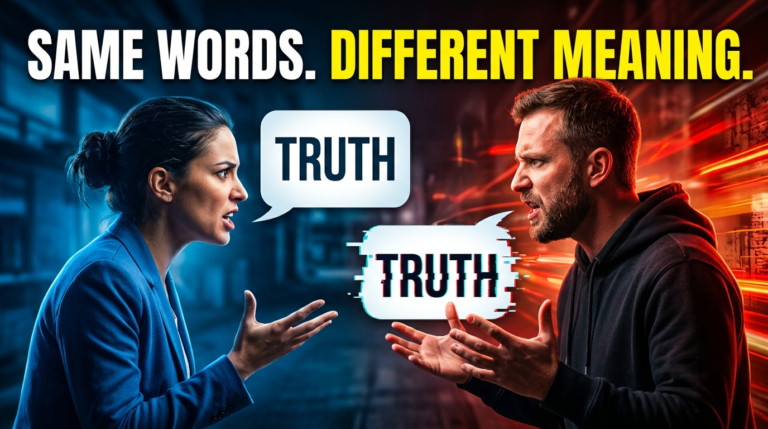
- You don’t share the same definitions for key words.
Noise in the situation
- People are watching (so everyone performs).
- The conversation is public and permanent.
- The topic is loaded (politics, race, religion, identity).
One big reason text-based communication breaks so often is that it doesn’t include many of the nonverbal clues we use in person—tone of voice, facial expression, body language. Researchers note that computer-mediated communication doesn’t benefit from those nonverbal cues, and those cues normally help us understand and reduce ambiguity.
That’s why sarcasm is a classic online disaster:
- You meant it as a joke.
- They read it literally.
- Now everyone’s mad.
Why social media turns the noise up
If social media were just a “bigger group chat,” it would still be hard. But it has built-in features that crank the noise louder.
Researcher danah boyd describes “networked publics” (online public spaces) as shaped by the properties of digital content. She lists four major “affordances” (features that shape what’s possible):
- persistence (posts stick around and get archived)
- replicability (content can be copied)
- scalability (visibility can get huge)
- searchability (people can find it later through search)
That means your words don’t just land once. They can land again and again—in new places, with new audiences, and with missing context.
boyd also names a few “central dynamics” that are perfect for understanding comment-section chaos:
- Invisible audiences (you can’t fully see who’s reading)
- Collapsed contexts (different groups collide in one space)
- Blurring of public and private (it’s hard to keep things separate)
So you might be “talking to” one group in your mind, but the actual audience is mixed.
That’s the perfect recipe for misunderstanding.
And there’s another online factor that matters: people often say things online they would not say face-to-face.
Psychologist John Suler describes the “online disinhibition effect,” where people self-disclose or act out more intensely online than in person. He lists factors like anonymity, invisibility, and asynchronicity (not talking in real time) that can contribute to this.
So not only do messages get distorted—people also get bolder, sharper, and meaner.
Which means the “noise” isn’t just accidental. Sometimes it’s fueled by the environment.
The main takeaway: miscommunication is a normal risk, not a weird exception
Here’s the core lesson Shannon helps us see:
Communication has multiple steps. Every step can bend the message.
Even if:
- the sender is honest
- the idea is good
- the words are clear (to the sender)
…noise can still shape what the receiver thinks was said.
Shannon even points out something that sounds very modern: redundancy and context can help people reconstruct meaning when parts of a message are received incorrectly (he uses English as an example where context can help you “fill in the blanks”).
That matches real life: You technically misheard the words, but the context helped you guess what was meant.
Online, context is often missing—so reconstruction fails.
So if you’ve ever thought, “How did they get THAT from what I said?” the answer is often:
- encoding wasn’t as clear as you thought
- the channel stripped away clues
- noise filled the gap
- the receiver rebuilt the meaning using their assumptions
Jesus, truth, and why this matters more than we think
Now let’s connect this to something deeper than “communication tips.”
In John 18, Jesus is questioned by Pilate. In the middle of this tense conversation, Jesus says something huge about why He came into the world:
He says He came “to bear witness to the truth,” and that those who are “of the truth” listen to His voice. Pilate responds with the famous line: “What is truth?”
That moment is not just about philosophy. It’s about a world where power, fear, pressure, and confusion make truth feel slippery.
And honestly, that’s how the internet often feels too:
- What’s real?
- Who’s lying?
- What do words even mean anymore?
- Is anyone listening to understand, or just to win?
Here’s the Christian claim that changes everything:
Truth is not just a concept we debate. Truth is something God speaks. And Christians believe Jesus doesn’t just talk about truth—He embodies it.
So yes, this post is about how communication breaks.
But it’s also a warning and a hope.
The warning:
If we ignore how noise works, we will keep hurting each other with careless words, rushed judgments, and bad-faith interpretations.
The hope:
Jesus calls us to something better than “owning” people and scoring points. He calls us to be people of truth—humble, honest, careful, and willing to listen.
And if Pilate’s question (“What is truth?”) is still echoing in our comment sections today, Christianity doesn’t answer it with a shrug. It answers it with a Person: Jesus, the One who came into the world to bear witness to the truth.
Sources
Claude E. Shannon, “A Mathematical Theory of Communication” (1948), for the source → transmitter → channel → receiver → destination model and the role of noise.
danah boyd, “Social Network Sites as Networked Publics: Affordances, Dynamics, and Implications” (2010), for persistence/replicability/scalability/searchability and invisible audiences / collapsed contexts.
Filik et al., “Sarcasm and emoticons: Comprehension and emotional impact” (2015), for how text-based (computer-mediated) communication lacks nonverbal cues that help remove ambiguity.
John Suler, “The Online Disinhibition Effect” (2004), for how online conditions can increase disinhibited behavior.
John 18:33–40 (ESV), for Jesus and Pilate’s dialogue and the “What is truth?” question.