Words Matter
Why Language Is More Than Just Communication
We live in a noisy world. Conversations happen everywhere – on social media, in comment sections, around dinner tables, and in the halls of government. Yet for all the talking we do, genuine understanding seems increasingly rare. People shout past each other. Debates generate more heat than light. Friendships fracture over conversations that go sideways.
What’s going wrong?
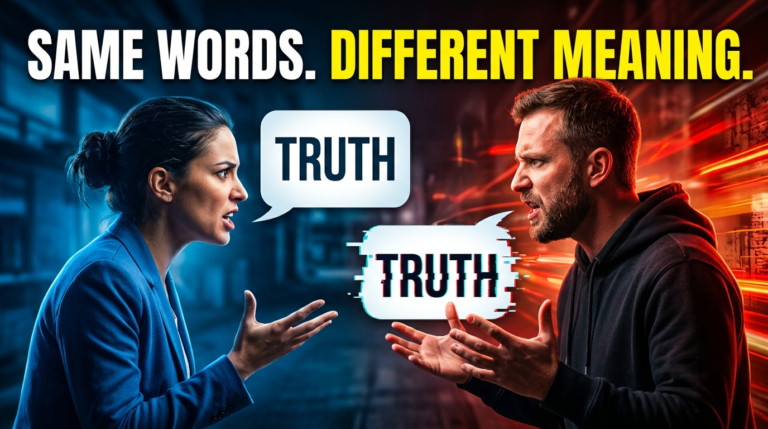
Part of the answer, I believe, comes down to something deceptively simple: many of our words have lost their shared meaning.
When Words Lose Their Shared Meaning
Consider a word like tolerance. For most of Western history, tolerance meant something like: “I disagree with you, but I will defend your right to hold your view.” It was a civic virtue built on the assumption that people would have different beliefs, and that coexistence required a kind of principled restraint.
Today, tolerance often means something closer to “You must affirm my view as equally valid.” Those two definitions are not just different – they are nearly opposite. One permits disagreement; the other forbids it.
When two people use the same word with opposite meanings, they are not having a disagreement. They are having two separate monologues. And no amount of passion or volume will bridge that gap.
George Orwell saw this coming. In his famous 1946 essay Politics and the English Language, he wrote that corrupted language reflects (and reinforces) corrupted thinking. When words become vague, he argued, they become weapons. They can mean whatever a speaker needs them to mean in the moment, slipping out of reach just when you try to pin them down.
The Case for Precision
Here’s what strikes me as a follower of Jesus: the Christian faith has always taken language with extraordinary seriousness.
The Gospel of John doesn’t open with a miracle or a genealogy. It opens with words:
“In the beginning was the Word, and the Word was with God, and the Word was God.” – John 1:1
The Greek term here is Logos — a word that carried enormous weight in the ancient world. It meant not just speech, but reason, order, meaning itself. John’s staggering claim is that Jesus Christ is the living embodiment of divine reason and communication. God did not send a feeling or a vague impression. He sent a Word — clear, incarnate, personal.
If the eternal God chose to reveal Himself through language, that tells us something important about language itself.
Words are not neutral. They are not mere sounds. They carry the power to heal or to wound, to build or to destroy, to clarify or to deceive. The way we use language is, in a very real sense, a moral issue.
Toward Better Conversations
So what do we do about it?
I want to suggest that the first act of genuine dialogue is not making your point – it’s defining your terms. Before you tell someone why they’re wrong, ask yourself: Do I actually understand what they mean? Not what you think they mean. Not what people who hold that view usually mean. What does this person mean, right now, in this conversation?
This is harder than it sounds. It requires slowing down. It requires intellectual humility – the willingness to be surprised. It requires treating the person across from you as someone worth understanding, not just someone to be defeated.
The truth is, straw men are easy to knock down. Intellectually honest communicators have to do the hard yards to deal directly with other people’s arguments – not the argument you think they are making. Slow down. Process what the other person is saying.
Everyone should be quick to listen, slow to speak and slow to become angry.
James 1:19
That’s not just good spiritual advice. It’s a philosophy of conversation.
Discernment Is Not Cowardice
That said, genuine dialogue requires a willing partner. Jesus Himself was not above walking away from a conversation. When the Pharisees tried to trap Him with trick questions, He often refused to play their game. Not every argument deserves a response, and not every antagonist deserves your energy.
In Luke 20, Jesus shuts down a conversation that He knew was fruitless. When the chief priests and scribes asked Him a question about whose authority Jesus was operating under (trying to trap him rhetorically), Jesus replied, “Neither will I tell you by what authority I do these things.”
Part of the wisdom of good engagement is learning to recognize when someone is genuinely searching for truth and when they are simply looking for a fight. Discernment is not cowardice. Knowing when to disengage — and finding someone else worth talking to — is itself an act of respect for the conversation.
Why This Blog Exists
This is the kind of thinking that drives everything you’ll find here. Culture is speaking – loudly, constantly, and with enormous confidence. But beneath the noise, there are assumptions being made, definitions being shifted, and ideas being smuggled in under familiar labels.
My goal is to slow down long enough to notice. To ask: What is actually being claimed here? What does that word really mean? And what does a Christian worldview have to say in response?
Not to win. To understand – and then, with clarity and grace, to engage.
Because words matter. They always have.