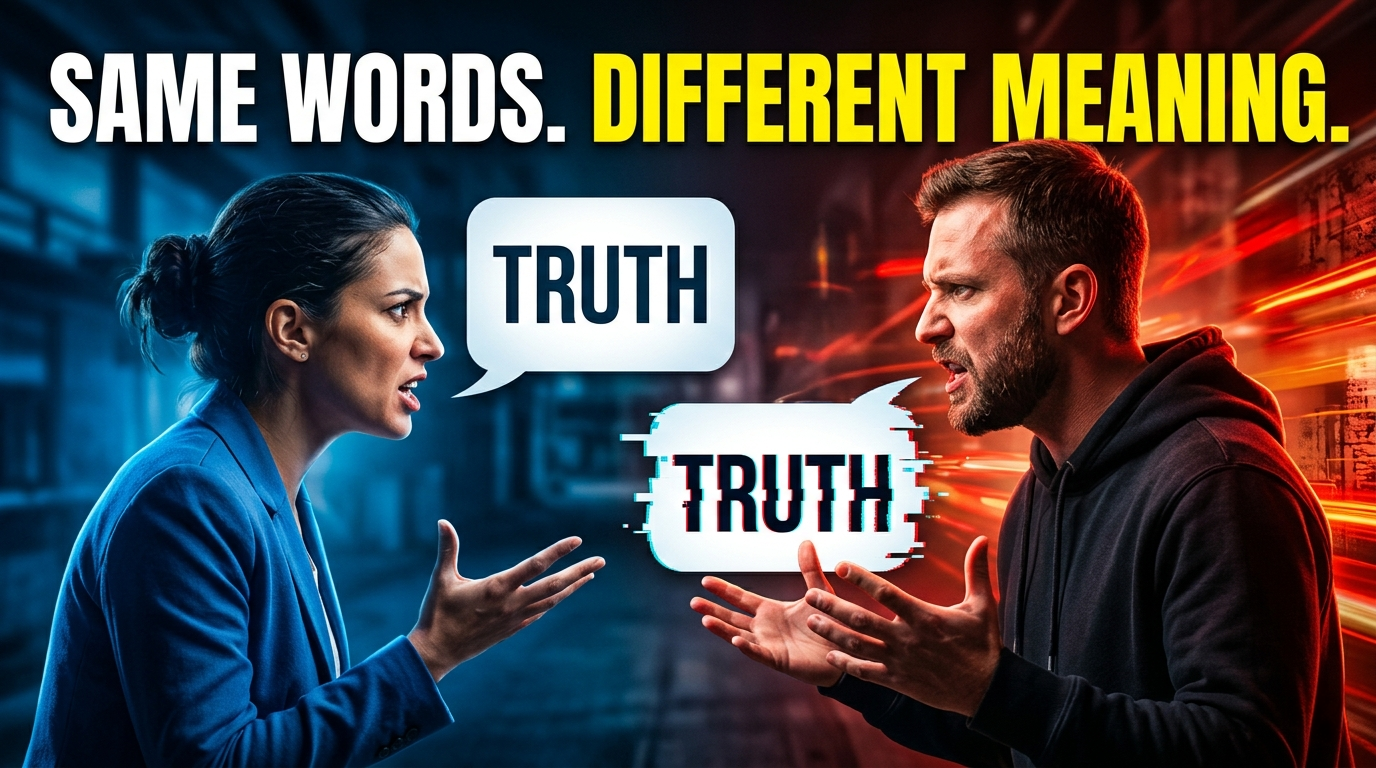
The Battle Over Meaning
Reflections on a Conversation About Language
I recently listened to a conversation between Doug Wilson and Jeff Durbin where the topic was something most people don’t think much about: bad words, offensive words, and language itself. But the discussion quickly turned into something much bigger – not just about words, but about meaning, context, culture, and communication.
The central idea was that not all objectionable language is the same. Wilson broke these words into four categories in the English language:
- Swearing – invoking God improperly (for example, using God’s name carelessly)
- Cursing – calling harm or judgment down on someone
- Obscenity – language or images that expose what should remain private or hidden
- Vulgarity – crude or coarse speech, often related to bodily functions or crude humor
At first, it seems pretty straightforward: avoid all of it. But the interesting argument was this:
The Bible prohibits all four categories in ungodly use,
but the Bible also contains “godly instances” of all four.
That idea forces you to think about something many people ignore:
Context Matters More Than Words Alone
The conversation kept coming back to one central principle:
Words are not just sounds. Words are tools used to communicate meaning, and meaning always depends on context.
The same can apply to images. Durbin brings up an example where showing graphic images of an aborted baby at a family dinner would be completely inappropriate. But showing the same images in a protest about injustice might be appropriate because the purpose is different.
Same image.
Different context.
Different meaning.
This applies to words too. The meaning of a word is not just in the dictionary – it is in how, where, why, and to whom it is spoken.
This connects directly to something very important about communication in general:
We are trying to communicate, not just speak.
If communication is the goal, then the question is not just, “is this word allowed?” The real question is, “what am I trying to communicate, and will this help or hurt that message?”
How Words Change Over Time
One of the most interesting parts of the discussion was about how the power of words changes over time.
Words that were once extremely offensive become normal. Words that were once normal become offensive. Expressions lose their original meaning and become harmless phrases.
Wilson brings up several expressions that mean nothing to most people today, yet were very offensive in their day/context. For example, “zounds” originated as a contraction of the mild oath “God’s wounds.” Today, no one would think anything of it. He went on to give other examples of everyday expressions that originally had religious or offensive meanings, but that people have completely forgotten. Over time, the emotional “voltage” drains out of words, and they become just sounds people use without thinking.
This shows us something important:
The meaning of words is not fixed forever in culture – it shifts as people use them differently.
This is happening constantly in our society today, especially online.
Words are being redefined, weaponized, softened and sharpened. Language is not static.
It is a battlefield, with several groups trying to gain the higher ground and dominate their opponents.
Culture, Subcultures, and Desensitization
Another interesting point was about subcultures – groups where certain language is normal even if it would be shocking elsewhere.
Wilson brought up the example where, as a submariner in the navy, he heard certain colorful language so often that he stopped noticing it. Over time, it became normal background noise. When he stepped back into a different environment, his ear became sensitized to the rough language again. Wilson was quick to point out that it is right and good for this re-sensitizing.
This happens to all of us. We become used to the language of the groups we spend time around. And the other side of that coin is that we also pick up on language we are not used to hearing, which means something very important:
The words we hear all the time slowly reshape what we think is normal.
That should make us pause and think about social media, comment sections, and online arguments. The tone, sarcasm, insults, and exaggeration we see every day slowly become normal to us. We likely don’t even realize it is happening.
Communication Is About Meaning, Not Just Words
The biggest takeaway from the conversation was this:
Language exists to communicate meaning. If we ignore meaning and focus only on words, we miss the whole point of language.
Two people can say the exact same sentence and mean completely different things. In fact, the exact same words can mean one thing to one person and literally the opposite to another.
I learned this the hard way. My wife is Australian. Several times while we were dating, I would say something along the lines of, “I really lucked out with you.” After this happened a few times, she finally asked me exactly what I meant (good for her!). It turns out that when an Australian says “lucked out,” they mean you are out of luck. When I say “lucked out,” I mean I was lucky.
Communication is not just words. Communication is intent, context, audience, culture, and interpretation all working together.
This connects directly to a bigger issue in our world right now:
We Are Not Just Arguing About Issues
We Are Arguing About What Words Mean
Many arguments today are not actually about facts. They are about definitions.
People redefine words. People accuse others of using the wrong definitions. People talk past each other because they are using the same words but different meanings.
This is why so many online arguments go nowhere. People are not communicating – they are transmitting words without shared meaning.
Why This Matters More Than We Think
If words, context and culture all can change meaning… and if people redefine words, then we run into a very serious question:
Is there any stable foundation for meaning at all?
If there is not, then communication eventually collapses.
We would just be making sounds and arguing about interpretations forever.
But if meaning is real, and truth is real, then communication has a foundation. This leads to a question that has been asked for thousands of years:
What is truth?
That question was actually asked directly to Jesus by Pontius Pilate during His trial (John 18:33–40).
Pilate was looking Truth in the face and asking,
“What is truth?”
And that question is still being asked today – in comment sections, in debates, in classrooms, and on social media. And everyone seems to be trying to claim the high ground. But what if truth is more than just a claim or set of claims. What if there is something greater than true claims? Something truer than true? What if truth is a person?
John 14 takes place during the Last Supper, the night before Jesus is crucified. The disciples are troubled because Jesus has told them He is leaving. Thomas asks Jesus how they can know the way if they don’t know where He is going. Jesus responds with the famous statement in John 14:6, saying, “I am the way, and the truth, and the life. No one comes to the Father except through me.” In context, Jesus is not just giving directions – He is saying that He Himself is the path to God, the source of truth, and the source of eternal life.
As Christians, we value truth because truth is not just an idea or set of claims. It is grounded in the unchanging character of God, who is Himself truthful.
Final Thought
Words matter because meaning matters. Meaning matters because truth matters. And truth matters because without truth, communication (and society itself) eventually falls apart.
We are not just arguing about politics, culture, or social issues. We are arguing about words, meaning, truth, and reality itself. And until we agree that truth exists and meaning matters,
we will keep talking past each other instead of to each other.
Questions to Think About
Here are some questions worth thinking about or discussing with others. While we know it is a little more nuanced than this, we use limited answers to force a choice to one side or the other.