Evidence, Testimony, and the Question Behind Every Argument
I recently watched a debate between Matt Dillahunty and Trent Horn about whether it is reasonable to believe that Jesus rose from the dead. But the debate wasn’t really about the resurrection. Not really.
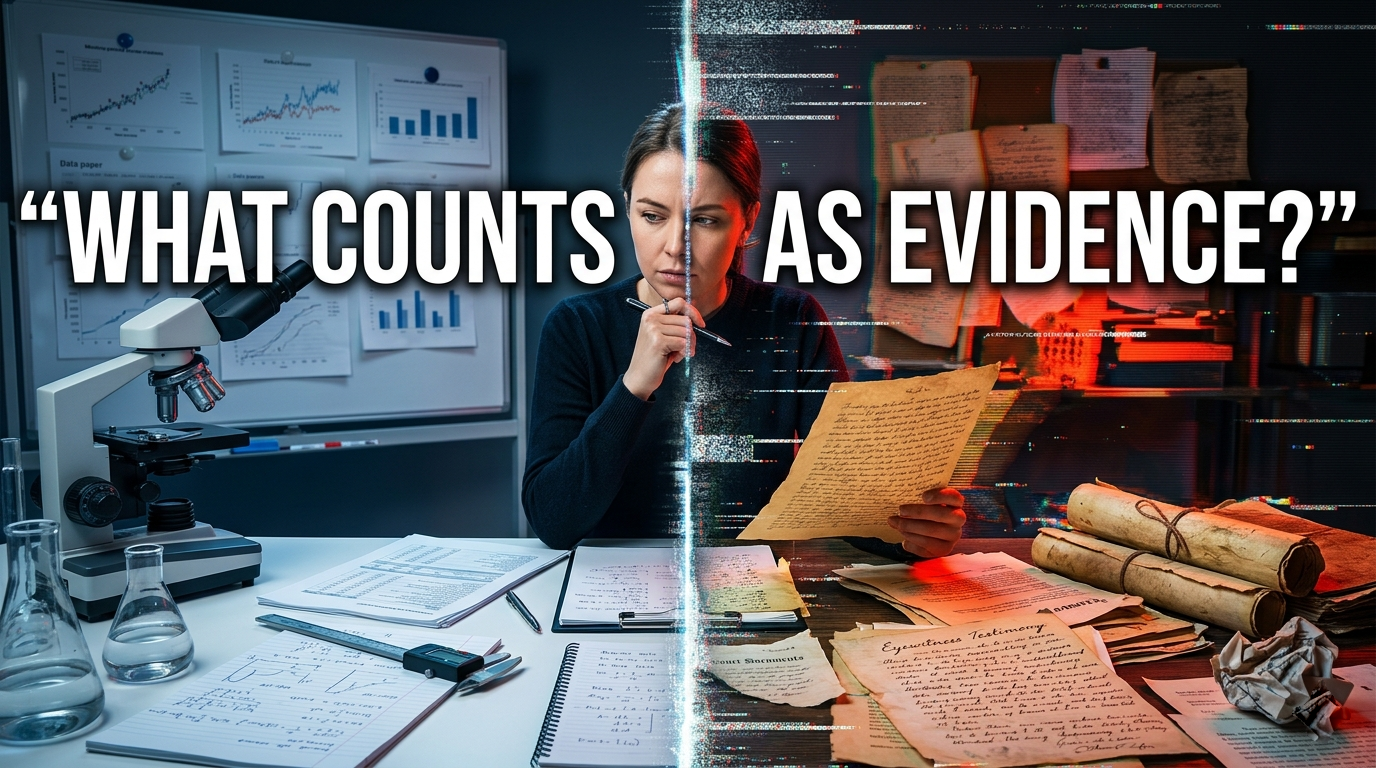
The debate was about evidence. What is it? What counts as evidence? How do we decide what is reasonable to believe?
And underneath that was an even deeper question: How do we know anything at all?
That question is not science. That question is epistemology. Phew. Big word. It’s just a word for the study of knowledge. And this is where things get very interesting. Do you start with what you know? Or do you start with understanding how we “know” anything?
Let’s be honest – our understanding of what we know and how we know it has dramatically changed since the Enlightenment. The Enlightenment was an intellectual movement that took place roughly from the late 1600s to the late 1700s, during which European thinkers began emphasizing human reason, skepticism of authority, and the study of the natural world through observation and experimentation.
During this period (and for millenia), the way people viewed evidence began to shift dramatically. Before the Enlightenment, testimony, historical records, tradition, and authority were often considered strong forms of evidence. After thinkers like Francis Bacon, René Descartes, and David Hume, people increasingly prioritized empirical, repeatable, scientific evidence over testimonial or historical evidence.
This shift helped give rise to modern science and many technological advances, but it also led many people to assume that only what can be scientifically tested is truly knowable, which is actually a philosophical assumption rather than a scientific conclusion. Many people hail the Enlightenment as a secular “Post Tenebras Lux” (Latin for “Light after darkness”), but they often forget that the scientific revolution and the foundations of the scientific method were largely developed by Christian and theistic thinkers who believed the universe was orderly because it was created by a rational God.
In short, the “evidence” for most of our scientific heroes pointed to God. Why? Let’s talk about that.
What Is Evidence?
Before we argue about miracles, history, science, or religion, we have to answer a basic question: What is evidence?
Evidence is simply this: information that supports a conclusion. But not all evidence is the same. There are different kinds of evidence:
Types of Evidence
- Physical evidence – objects, fingerprints, fossils, bones, artifacts
- Scientific evidence – repeatable experiments and measurements
- Testimonial evidence – eyewitness testimony, written accounts, historical documents
- Circumstantial evidence – indirect evidence pointing to a conclusion
- Statistical evidence – probability and patterns
- Logical evidence – conclusions drawn through reasoning
- Experiential evidence – personal experience
- Historical evidence – documents and testimony from the past
Most people talk about evidence as if only scientific, repeatable, physical evidence counts, but that’s not how humans actually operate in the real world. Not only is testimonial evidence useful, but we reply on it.
Courts rely heavily on testimony. This is because many cases cannot be decided by physical evidence alone. In some cases, the physical evidence can be misleading if important facts are not known. Courts regularly rely on eyewitnesses, expert witnesses, and personal accounts to determine what most likely happened in the past. The legal system does not assume testimony is worthless; instead, it evaluates whether witnesses are credible and consistent.
Medicine often relies on testimony from patients because many symptoms – like pain, dizziness, fatigue, or anxiety – cannot be directly measured with a test or scan. Doctors often make diagnoses and treatment decisions based largely on what patients report about their symptoms, when they started, and how they feel. In this way, patient testimony is an important form of evidence in medical practice.
History relies almost entirely on testimony. In fact, when we talk about historical evidence, we have to remember that most of what we know about ancient history comes from written testimony. By that standard, Jesus of Nazareth is actually one of the better-attested figures of the ancient world, with multiple independent sources written within decades of His life.
And even in daily life, we constantly rely on the testimony of others without even thinking about it. For example, most people believe the weather forecast without personally studying atmospheric data, and we trust mechanics, doctors, teachers, and pilots even though we cannot personally verify everything they tell us. Much of what we know about the world – from history to geography to current events – comes not from our own direct observation, but from trusting the testimony of other people we believe are knowledgeable or trustworthy.
You believe most of what you believe about the world because someone told you, and you trusted them.
The Real Question: How Much Evidence Is Enough?
One of the main points in the debate was this idea: the more extraordinary the claim, the stronger the evidence required. That idea is often associated with philosopher David Hume. But is that really true?
Matt Dillahunty’s position basically comes down to this: Testimony alone is not enough for an extraordinary claim like a resurrection.
Trent Horn’s position is: Multiple sincere testimonies, especially costly testimony, can be sufficient evidence for extraordinary events.
So the disagreement is not really about the resurrection. It is about standards of evidence. But there is something even deeper going on.
Epistemology Comes Before Science
Here is a very important philosophical point that often gets missed: You must decide what counts as evidence before you can do science.
Science does not tell you what evidence is. Science uses evidence.
But how do we know observation is reliable?
How do we know experiments tell us truth?
How do we know our senses are trustworthy?
How do we know logic works?
How do we know the future will behave like the past?
Those are not scientific questions. Those are epistemological questions. You cannot use science to justify science without circular reasoning. So in a very real sense, epistemology must come before the scientific method.
Before you can run an experiment, you must already believe in the laws of logic. You must presuppose:
- The Law of Identity
- The Law of Non-Contradiction
- The Law of Excluded Middle
None of those things can be proven by the scientific method itself. They are assumptions that make science possible. The laws of logic are not discovered in a laboratory; they are the rules that make laboratories, science, reasoning, and communication possible in the first place. They are what we call necessary truths or preconditions of reasoning.
But wait, there’s more!
The Uniformity of Nature Assumption
This connects directly to something said in the debate about miracles and the laws of nature. If someone says, “Miracles cannot happen because they violate the laws of nature,” you can ask, “How do you know the laws of nature can never be suspended?”
You cannot scientifically prove that miracles never happen, because that would require observing all of reality for all time. You cannot prove a universal negative like that. And no one should be asked to prove a universal negative. But interestingly, science itself depends on something called “Uniformity of Nature” (The idea that the laws of nature behave consistently over time).
But why should nature be uniform?
Why should gravity work tomorrow?
Why should physics behave the same in another galaxy?
Science assumes uniformity – it does not prove it.
This is actually one of the oldest philosophical problems in science, known as the Problem of Induction, discussed by David Hume.
Testimonial Evidence and Everyday Life
One of the most interesting parts of the debate was about testimonial evidence. Matt’s position was basically: Testimony alone cannot make an extraordinary claim reasonable. But think about how much of your life is based on testimony (and reasonably so!). You believe:
- Historical events
- Most scientific discoveries
- Geography
- News reports
- Medical advice
- What your friends tell you
- What teachers tell you
- What books tell you
You have not personally verified most of what you believe. You trust testimony from reliable sources. So the real question is not “Is testimony evidence?” The real question is, “When is testimony enough evidence?” That is a much harder question.
Reasonable According to What Standard?
Matt kept using the word reasonable. But that raises another important question: Reasonable according to whose standard? If someone says it is unreasonable to believe miracles based on testimony, then they are making an epistemological claim – not a scientific one.
They are saying: My standard for what counts as evidence excludes miracles.
But that standard itself cannot be proven scientifically. It is a philosophical starting point. So in the end, the debate comes down to not just evidence, but what we allow to count as evidence in the first place.
And that decision is influenced heavily by worldview. Like it or not, Matt Dillahunty is not as evidence-based as he would like to believe. It’s important for every one of us to be fair and honest about our preconceived notions.
That’s not a plea to throw our hands up in the air and quit. It’s a plea to be honest, humble, kind and genuine when in conversations with people with which we disagree.
The Question Behind the Debate
So the debate is not really about “Did Jesus rise from the dead?” The deeper debate is:
Can testimonial evidence ever be enough for a claim? (even an extraordinary one)
Can the laws of nature ever be suspended? (and how would we know?)
What counts as evidence? ( and who gets to decide this?)
What makes a belief reasonable? (and what evidence would you use?)
How do we know anything at all? (be careful… your head might start freewheeling here)
These are not scientific questions. These are philosophical questions about knowledge itself, and most debates about religion and science are actually debates about epistemology, even if people don’t realize it.
Questions to Think About
Here are some questions worth thinking about or discussing with others. While we know it is a little more nuanced than this, we use limited answers to force a choice to one side or the other.